
Newton County Arrest to Court Record
A Newton County jail arrest and a Newton County court record are two linked but different records. The jail booking is an administrative custody record. It documents intake, arresting agency details, booking charges, bond, holds, and release or transfer status if the information is obtained from the sheriff. A court record begins when a charging instrument, complaint, information, indictment, warrant return, or related filing reaches the correct court or clerk.
The Criminal District Attorney reviews law-enforcement reports and decides whether to file, amend, reduce, dismiss, or present charges to a grand jury. Because that review can change the charge name or count, a jail booking charge is not the same thing as a conviction. For custody and booking details, use sheriff records. For court records after an arrest, use the clerk or court path tied to the filed case.
Newton County Court Record Routing
Official Newton County pages identify the Criminal District Attorney, District Clerk, County Clerk, County Court, District Court, and Justice of the Peace routes around the Newton County Courthouse. The main courthouse phone shown on multiple pages is 409-379-5691. Direct criminal division extensions were not located in the research, so court-record users should avoid guessing and route through the official office pages or courthouse phone when the case level is unclear.
| Record or charge type | Likely Newton County route | Research note |
|---|---|---|
| Felony filings | District Court / District Clerk | Use District Clerk routing for district-court criminal cases. |
| Misdemeanor filings | County Court / County Clerk | Use County Clerk or County Court routing where local case assignment applies. |
| Fine-only or some warrant matters | Justice of the Peace or municipal court | JP Precinct 1 public phone is 409-397-4545. |
| Appeals | Texas Judicial Branch appellate search | Not a trial-court case file. |
| Statewide electronic access | Re:SearchTX | Use only where records and access rules permit. |
Newton County Charging Documents
Court records after a jail arrest often center on the document that formally charges the case. The research identifies complaint, information, and indictment as core terms. These documents are not the same as the jail booking sheet. They are part of the court path and may be filed after the booking event. Felony cases may move by indictment, while misdemeanors may proceed through complaint or information depending on the charge and local process.
| Document | Plain meaning | Why it matters after arrest |
|---|---|---|
| Complaint | Sworn charging paper often used early in a case. | May appear before full prosecutor review is complete. |
| Information | Prosecutor-filed charging document. | Often reflects reviewed charges more than the jail booking text. |
| Indictment | Grand-jury charging document. | Common felony route when a grand jury returns charges. |
Find Court Records After Arrest
The practical Newton County path starts with the sheriff only if the first question is custody, booking date, arresting agency, or booking charge. After that, the search shifts to court records. A person may be released from jail while the court case remains pending, and a person may remain jailed while the filed charge changes. Keep those tracks separate.
- Confirm the booking and arrest date through the sheriff if custody status or jail records are needed.
- Ask whether a magistrate, court, or case number has been assigned.
- Contact the District Clerk for felony filings or the County Clerk/County Court route for misdemeanor filings.
- Use Re:SearchTX when available for public trial-court electronic records.
- Use the Texas appellate case search only for appellate records, not the original jail case.
- Use Texas DPS Conviction Name Search for statewide public conviction-history searches.
Newton County Case Search Fields
The Texas Judicial Branch appellate case search is an official state court search page, but it is not the Newton County trial-court criminal file. Its own notice says data and documents refresh nightly, are not real-time, and trial-court information should be obtained from the court clerk or Re:SearchTX where available. It is still useful when a Newton County case reaches an appellate court.
| Field | What it does |
|---|---|
| Court | Selects an appellate court, not the local trial-court jail charge record. |
| Case No. / Partial Case No. | Searches by exact or partial appellate case number. |
| Civil / Criminal | Filters the appellate case category. |
| Date Filed from/to | Limits results by filing date range. |
| Style v. | Searches party or case style text. |
| Trial Court County | Includes Newton as a dropdown choice. |
| Trial Court | Includes Newton County trial courts among many Texas courts. |
The Texas appellate case search page shows the statewide fields and county dropdown.
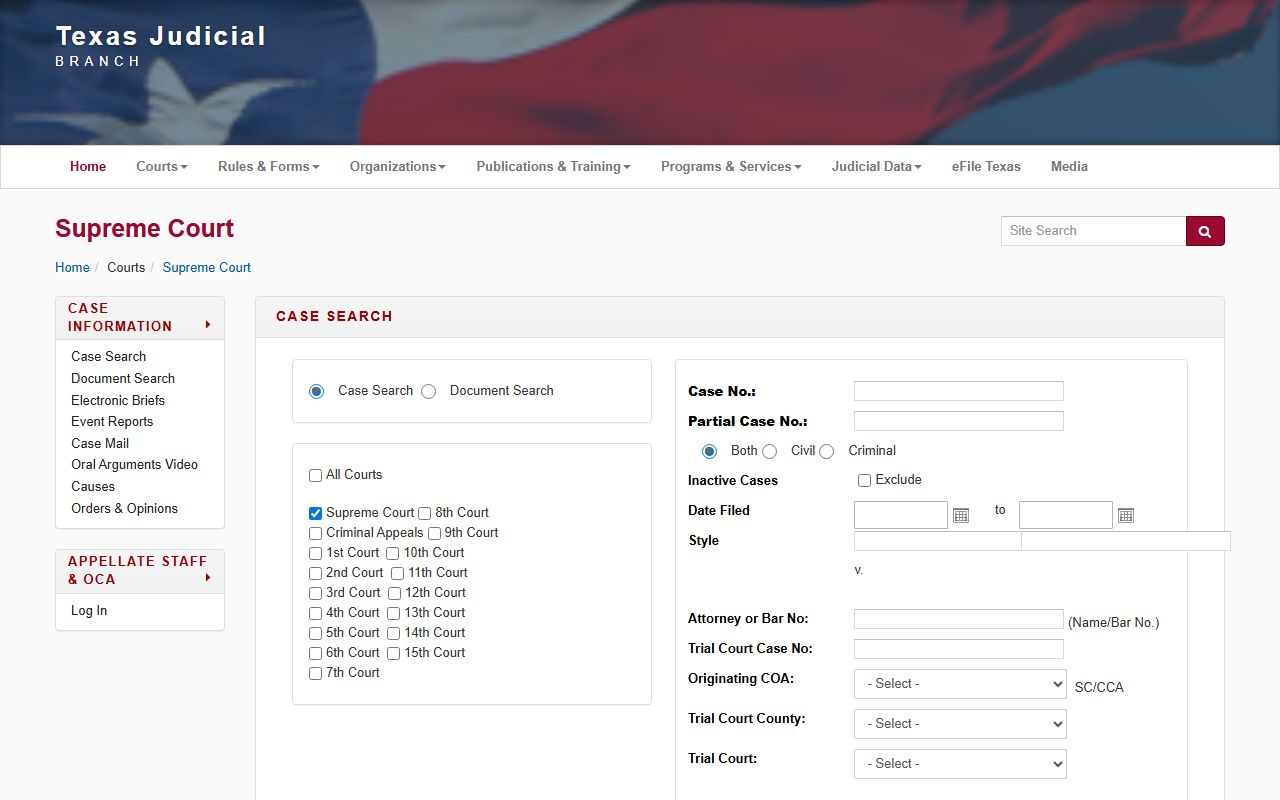
Use that portal for appeals and use Newton County clerks or Re:SearchTX for trial-court records after a jail arrest.
Newton County Charge Status
A charge status term describes where the court record stands. It should not be read as a custody status or a final background-check conclusion without the full court record. A pending charge is not a conviction. A dismissed charge may still have an arrest record unless expunction or another court order applies. Deferred adjudication has Texas-specific effects and should be verified from the case file.
| Status | Meaning in court records after arrest |
|---|---|
| Pending | Filed but not resolved. |
| Amended | Charge was changed by prosecutor or court action. |
| Reduced | Charge lowered to a lesser offense. |
| Dismissed | Charge ended without conviction. |
| No-billed | Grand jury did not indict. |
| Convicted | Guilt adjudicated by plea or verdict. |
| Deferred adjudication | Texas supervision outcome that may not be a final conviction in every context. |
Charge vs Conviction Records
Court records after a Newton County jail arrest can show a charge long before they show a conviction. The jail may have one charge label at booking. The Criminal District Attorney may file a different charge. The court may later amend, reduce, dismiss, or dispose of the case. Public users should avoid treating an arrest as proof of guilt.
| Record type | What it means | Where to verify |
|---|---|---|
| Booking charge | Charge recorded at jail intake. | Sheriff booking record or jail record. |
| Filed charge | Charge accepted or filed in court. | District Clerk, County Clerk, County Court, JP, or Re:SearchTX. |
| Conviction | Final guilt finding by plea or verdict. | Court disposition or DPS conviction search. |
Booking and custody records are handled separately from the court case. The Newton County inmate records page focuses on the custody side.
Warrants and Bond After Arrest
No official Newton County active warrant search or most-wanted list was located. Warrant questions should be routed to the sheriff, the relevant court clerk, a JP or municipal court for fine-only or bench-warrant matters, or the public-records process. A booking record may show a warrant, issuing court, bond amount, no-bond status, or hold, but court records can later change bond or case status.
Bond is set or reviewed after arrest based on the charge, warrant status, criminal history, public-safety factors, and statutory limits. A parole or blue warrant, bench warrant, TDCJ transfer status, federal hold, ICE detainer, or no-bond charge may prevent release even if another charge has a bond amount. Call the sheriff before trying to post bond, then verify court filings with the correct clerk.
Expunction and Sealed Records
Texas law provides record-clearing routes, but they are not automatic just because a person was released, charges were dismissed, or a mugshot is embarrassing. Texas Code of Criminal Procedure Chapter 55A governs expunction of eligible arrest records. Expunction can affect what agencies may release, but eligibility and effect depend on the court order and case history.
| Term | Plain meaning | Practical effect |
|---|---|---|
| Expunction | Court order clearing eligible arrest records. | May restrict agency release after the order is entered. |
| Nondisclosure or sealed record | Limits public access to certain records. | May not erase every agency record or private copy. |
| Dismissal without order | Charge ended, but no clearing order is shown. | Arrest and case records may still exist unless law or court order limits release. |
Note: Verify record-clearing status from the court order, not from the absence of a jail roster entry.